Customs
For shipments to non-EU countries, import customs duties may apply. Please inform yourself before ordering about what these duties are and what their amount is.
We have provided some information for you on this page.
Whether and to what extent import duties are incurred depends on the intrinsic value and the type of shipment. The value limits apply to private individuals and commercial recipients, regardless of whether the goods were transported under the Universal Postal Convention or by an express or courier service provider. These value limits also apply to gifts from or to companies.
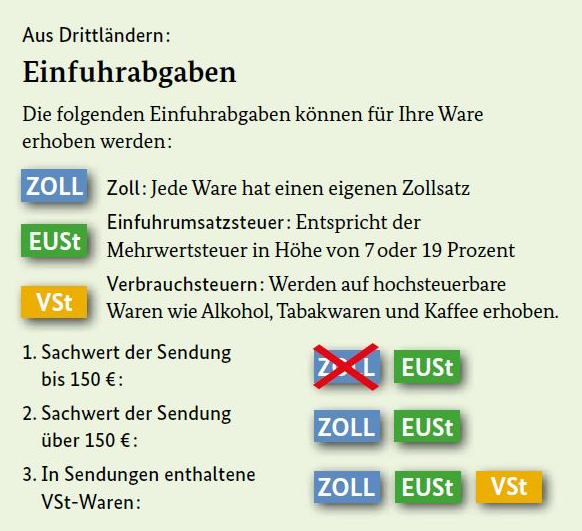
The intrinsic value of the shipment is decisive for determining whether the value limit of 150 euros has been met. The decisive factor is the amount actually paid to acquire the goods. If the final invoice amount includes postage costs that are not clearly identifiable or separately itemized, they remain part of the intrinsic value. The same applies to taxes and duties (e.g., VAT owed in the Union or third-country VAT) if they are listed in the relevant documents (e.g., invoice).
Example 1:
The total invoice amount consists of the price for goods and transportation costs.
Price for the goods on the invoice: 140.00 Euros
Transportation costs on the invoice: 20.00 Euros
Total invoice amount: 160.00 Euros
In this case, the intrinsic value of the goods is 140.00 Euros.
Example 2:
The total invoice amount includes transportation costs. It is not apparent from the invoice or other documents whether and to what extent transportation costs are included in the invoice price.
Total invoice amount: 160.00 Euros.
In this case, the intrinsic value of the goods is 160.00 Euros.
Example 3:
The total invoice amount consists of the price for goods, transportation costs, and German VAT.
Price for the goods per invoice: 140.00 Euros
Transportation costs per invoice: 20.00 Euros
VAT (19%) per invoice: 30.40 Euros
Total invoice amount: 190.40 Euros
In this case, the intrinsic value of the goods is 140 Euros.
Example 4:
The total invoice amount consists of the price for goods, third-country VAT, and transportation costs.
Price for the goods per invoice: 140.00 Euros
Total invoice amount: 195.00 Euros
In this case, the intrinsic value of the goods is also 140 Euros.
The assessment and payment of excise duty for alcoholic products, tobacco products, tobacco product substitutes, as well as roasted coffee, instant coffee, and coffee-containing goods, takes place regardless of the intrinsic value of the shipment.
Tobacco products and tobacco product substitutes (e.g., e-liquid for e-cigarettes) must bear a valid German tax stamp upon import. This also applies to products treated as tobacco products that consist wholly or partially of other substances instead of tobacco (e.g., herbal cigarettes).
Intrinsic value not greater than 150 Euros
For shipments with an intrinsic value of no more than 150 Euros, the shipments are duty-free, but import VAT at 19 percent or 7 percent and excise duty (for consignments of goods subject to excise duty) must be levied. When calculating import duties, the total amount of the shipment, including postage costs, is used as the basis. This is referred to as the customs value.
In principle, a customs declaration must be submitted for all shipments from a third country. This task is usually carried out for you by the carrier of the goods, i.e., the responsible postal or courier service. This carrier also pays the import duties due to customs. As a rule, you then have to pay the duties to the carrier upon delivery of the shipment.
However, duties of less than one euro are not levied. These duty-free postal and courier shipments can be delivered directly as before, provided there are no prohibitions or restrictions.
For the service (customs declaration of the shipment and payment of duties), the postal or courier service usually also charges a service fee. Please inquire with the responsible postal or courier service or refer to their General Terms and Conditions (GTC) to find out whether and to what extent a service fee may be charged.
If your seller in a third country registers in the EU's new VAT system and uses the Import One Stop Shop (IOSS), no additional fees (import duties) will be incurred at customs for goods with a value of up to 150 euros that you purchase outside the EU.
However, since the seller is obliged in this case to pay the duties due to the EU via the aforementioned VAT system, these duties are usually already included in the seller's final invoice amount.
The obligation to submit a customs declaration still exists and is usually undertaken for you by the carrier (usually postal or courier service provider). Please refer to the General Terms and Conditions (GTC) of the seller or carrier to find out whether and to what extent an additional service fee will be charged for this service.
Please note that different regulations apply to the import of excise duty goods such as alcohol, tobacco, and coffee.
Intrinsic value greater than 150 Euros
For an intrinsic value of more than 150 Euros, duties are calculated according to the customs tariff.
Duty calculation according to the customs tariff
When calculating duties according to the customs tariff, each applicable type of duty (e.g., tobacco tax, customs duty, and import VAT) is calculated individually.
The amount of import duties depends not only on the customs value, but also on the type and nature of the goods. The amount of import duties then results from the duty rates specified in the Common Customs Tariff of the European Union and national tax laws.
The term customs value does not correspond to the term intrinsic value.
The total amount of import duties results from the following types of duties:
- Customs duty for all imported goods,
- possibly excise duties, which include energy tax, tobacco tax, alcohol tax, alcopop tax, beer tax, sparkling wine and intermediate product tax, and coffee tax, for all excise duty goods, and
- Import VAT for all imported goods.
The customs duty amount to be paid results from the customs value of the goods and the corresponding customs duty rate. The customs value is determined according to the general customs valuation regulations.
Examples of types of goods and their import duty rates for import into the EU
The excise duties to be levied are generally calculated based on the quantity of goods imported and the corresponding excise duty rate.
The assessment basis for import VAT is the customs value plus customs duty and, for goods subject to excise duty, also plus the applicable excise duties.
The import VAT rate is calculated at 19 percent; for some goods, such as food or books, a reduced rate of 7 percent applies. When calculating the customs value, the exchange rate valid on the day the customs declaration is accepted is used.
Import duty calculation for goods with a value greater than 150 Euros
Is postage taken into account when duties are levied?
The assessment basis for duty calculation is the customs value. Invoices or other documents regarding the price paid or to be paid must be submitted in full. If postal charges are invoiced, they are included in the calculation of the customs value.
Since postage or postal charges are not calculated based on kilometers transported, a division into costs incurred within and outside the Union is not considered.
Returns from non-EU countries
For returns from non-EU countries, it is absolutely essential that the shipment is correctly declared as Return of Goods and that an invoice is attached to the outside of the package.
If this is not done, delays or storage at customs may occur. In such cases, we reserve the right to refuse acceptance or to pass on any customs and processing costs to the customer.
We assume no liability for returns that cannot be delivered due to missing or incorrect declarations.